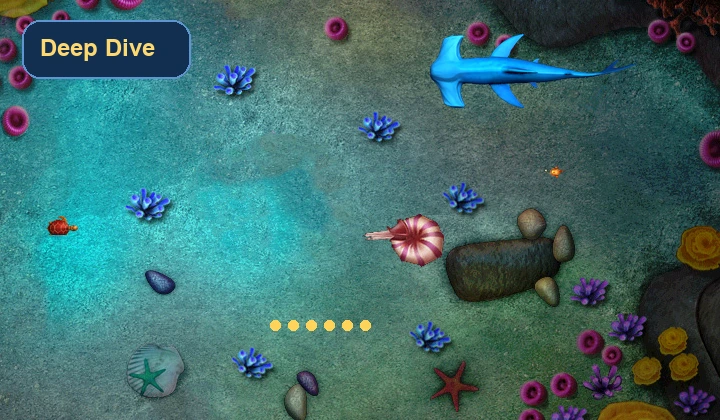
The trick is not realism. It is rhythm. A fishing arcade game gets sticky when you can read a lane quickly, take a shot with confidence, and get feedback fast enough that one good hit naturally turns into another attempt.
Readable fish paths do half the job
Most new players think the genre is about clicking fast. It is not. It is about understanding movement early enough to feel clever when you fire. Fish that cross in readable arcs create a tiny prediction game every few seconds. That prediction is what keeps the screen interesting.
When the pathing is too random, the fun disappears. When it is too obvious, the game becomes sleepy. The best runs live right in the middle, where you feel rewarded for paying attention.
Coin pops and hit feedback create momentum
Nothing kills a fishing game faster than vague feedback. A hit should feel immediate. Coins, score pops, flashes, recoil, and sound cues all work together to make the player trust what just happened. That trust matters because it turns each shot into momentum instead of noise.
This is also why bigger fish matter so much. Even when they move slower, they carry emotional weight. You track them longer, line the shot up more carefully, maybe hesitate for a split second, and the payoff feels better when it lands.
Fast resets keep the loop alive
One more try only works when the reset is painless. Browser games are extra sensitive to that because people are not always planning a long session. They might be taking a short break, testing one route, or reopening the page after a day away. If the game gets them back into the loop quickly, they stay.
That is why a compact route like Deep Sea Mode helps so much. The playfield is clear, the hint text is short, and the next round is never far away.
Small differences in framing change the mood
The core game can stay the same while the feeling changes a lot depending on the route around it. Ocean Hunter feels more aggressive because the page nudges you toward a busier pace and quicker reads. Classic Arcade works as a break because it swaps target tracking for a brighter luck-based loop. Those shifts help the whole site feel lived in.
Short runs are part of the appeal
A good fishing game does not need to trap you for an hour. In fact, part of the appeal is that the runs feel complete even when they are short. One solid minute can still feel satisfying if the movement is readable and the feedback lands the way it should. That makes the genre perfect for browser play.
Why people come back
People come back because the loop is easy to restart and surprisingly hard to exhaust. There is always one cleaner shot, one better lane, or one bigger fish drifting into view. The game keeps offering tiny moments of improvement without asking the player to relearn everything from scratch.
That is the real secret. The genre stays simple on the surface while quietly giving the player enough rhythm and feedback to keep reopening the page.